
Machines vs Free Weights for Beginners: Which One Works
Starting a strength training routine is confusing when you’re deciding between machines and free weights. We’ll walk you through the pros and cons of each so you can pick what actually fits your goals and experience level.
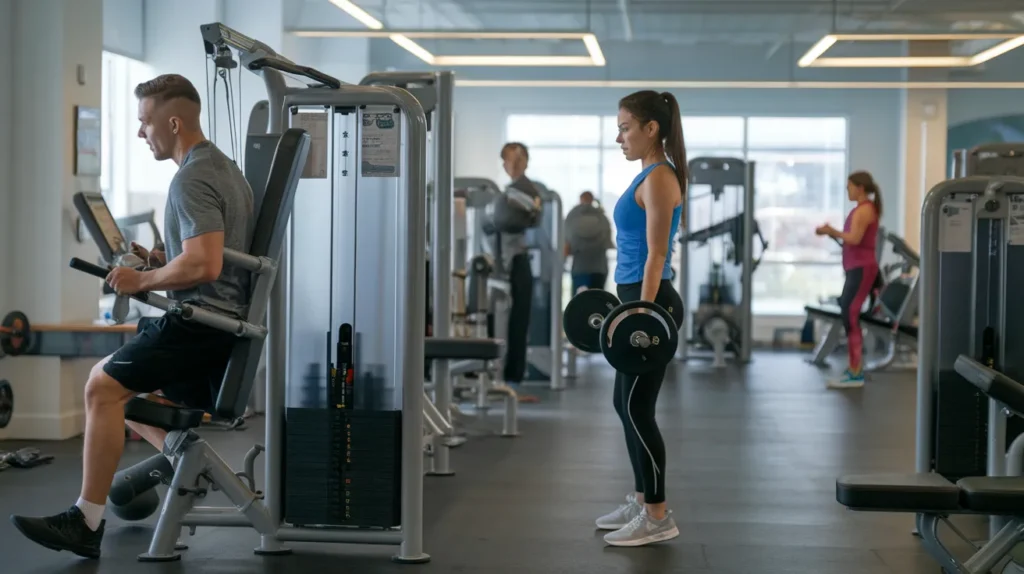
This guide helps beginners answer the question: Should beginners use machines or free weights? The truth is that you need both, but in the right order and for different reasons.
Most people think machines are for beginners and free weights are for advanced lifters. This is completely backwards because it confuses safety with simplicity. Machines lock you into fixed movement paths that often don’t match your body’s natural mechanics. This can actually create more risk of injury for someone who doesn’t yet know how their body should move under load.
Should beginners use machines or free weights? Start with both but focus differently
Your first month should include mostly free weights with some machine work. Free weights teach you how to control your body in space. They force you to balance and stabilize yourself. These skills matter more than the weight you lift.
Machines serve a specific purpose for beginners. They let you practice pushing and pulling movements without worrying about balance. This helps you learn what different muscles feel like when they work. But machines should take up less than 30% of your training time at the start.
Free weights mean dumbbells, barbells, and kettlebells. They move in any direction you push or pull them. Your body must work harder to control them. This builds coordination along with strength.
Free weights force you to learn movement patterns that transfer everywhere
A barbell squat teaches you how to sit down and stand up under load. This movement shows up when you pick up your kid or grab a heavy box. The leg press machine only teaches you how to use the leg press machine.
Free weight exercises work multiple muscles at once. A dumbbell shoulder press strengthens your shoulders, arms, and core together. Your body learns to work as a system. Machines isolate single muscles, which has value later but not when you’re learning the basics.
Your stabilizer muscles only get strong with free weights. These small muscles keep your joints safe during movement. Machines remove the need for stabilization. This leaves gaps in your strength that can cause problems down the road.
Machines work best for three specific situations when you’re starting out
Use machines when you’re extremely tired. Your last exercise of the day can be on a machine. Your coordination drops when you’re fatigued. Machines keep you safer when your form starts to break down.
Machines help you understand muscle contraction. The chest press machine shows you exactly what it feels like when your chest muscles work hard. This awareness helps when you move to dumbbell pressing. You’ll know which muscles should be doing the work.
Some machines fill gaps that free weights don’t address well. The lat pulldown machine is excellent for building pulling strength before you can do a pullup. The leg curl machine trains your hamstrings in a way that’s hard to replicate with free weights alone.
Your first workout should look like this with a clear split
Start every workout with a free weight movement. Pick one main exercise like the goblet squat, dumbbell bench press, or barbell deadlift. Do this exercise first when you’re fresh and can focus on form.
Add two or three more free weight exercises that work different movement patterns. These can use lighter weights. The goal is to practice different ways of pushing, pulling, squatting, and hinging.
Finish with one or two machine exercises. Choose machines that work muscles you didn’t hit hard with free weights. Keep the weight moderate and focus on the muscle contraction. This is where machines shine.
The learning curve matters more than you think
Free weights take longer to learn but the investment pays off forever. Your first few weeks will feel awkward. You’ll use lighter weights than you think you should. This is normal and necessary.
Video yourself doing free weight exercises. Watch the videos between sets. This shows you what you’re actually doing versus what you think you’re doing. The difference is usually significant at first.
Machines let you push harder sooner without much technique practice. This feels good in the moment. But you’re building strength without the movement skills to support it. This creates problems when you eventually try free weights with heavier loads.
Balance and coordination are strength qualities you can’t skip
Standing on one leg while holding a dumbbell overhead requires strength. It also requires balance, coordination, and body awareness. Machines completely remove these requirements. You end up strong in limited, predetermined paths.
Free weights train your nervous system differently. Your brain must constantly adjust to keep the weight moving in the right direction. This creates different adaptations than simply pushing against a fixed machine path.
Real world strength almost never happens on a stable, balanced surface. You lift things while twisted, off balance, or in awkward positions. Free weights prepare you for this reality. Machines don’t.
Common injuries happen when beginners make these mistakes with each type
Free weight injuries usually come from using too much weight before learning proper form. Beginners see others lifting heavy and try to match them. This leads to compensations and eventual pain. Start lighter than feels necessary.
Machine injuries are less common but more insidious. The fixed path might not match your body structure. Your shoulder might track differently than the machine expects. You feel fine for weeks, then develop chronic pain.
The seated leg extension machine is a perfect example. It puts enormous stress on your knee ligaments in a way that never happens naturally. Many beginners use it because it seems safe and simple. It often creates knee problems over time.
Your program should evolve but keep this ratio throughout
Aim for about 70% free weights and 30% machines in your first six months. This ratio gives you the movement practice you need while still getting the benefits machines offer. Track this over a week, not in single workouts.
As you get stronger, you might shift to 80% free weights or higher. Some people eventually use almost no machines. Others keep several machines in their program permanently. Both approaches work once you have the foundation.
The question of should beginners use machines or free weights assumes you must choose one. You don’t. You use both strategically. Free weights build the foundation. Machines add volume and work around fatigue or weak points.
These specific exercises should form your free weight foundation
The goblet squat teaches you to squat properly while holding weight at your chest. This is safer and more natural than a barbell back squat for beginners. Master this before moving to barbell variations.
The Romanian deadlift with dumbbells trains your hamstrings and teaches the hip hinge pattern. This movement protects your back in daily life. The form is easier to learn than a conventional barbell deadlift.
Dumbbell bench press and overhead press work your upper body pushing muscles. Dumbbells let each arm work independently. This prevents your strong side from compensating for your weak side.
Dumbbell rows and face pulls train your upper back. These movements balance out all the pressing work. They also improve your posture, which most beginners need desperately.
Machines that actually help beginners without creating bad habits
The cable row machine lets you practice pulling with perfect form. The cable keeps constant tension on your muscles throughout the movement. This teaches you what a good row should feel like.
The lat pulldown prepares you for pullups and chinups. Most beginners can’t do a full pullup yet. This machine lets you train the same muscles with adjustable weight.
The chest supported row removes your lower back from the equation. You can train your upper back hard without worrying about your back getting tired first. This is useful when you’re building volume.
The leg press has value despite what some purists claim. It lets you load your legs heavily when you’re still learning to squat. Just don’t make it your only leg exercise.
Skip the Smith machine for now. It combines the worst aspects of machines and free weights. The bar moves on a fixed vertical track but you must still balance it. This creates awkward movement patterns that don’t transfer anywhere.
Start your next workout with a simple goblet squat using a light dumbbell or kettlebell, focusing entirely on sitting back into your hips while keeping your chest up.
Frequently Asked Questions
Can I build muscle using only machines?
You can build muscle with only machines but you’ll have gaps in your strength and movement ability. Machines grow muscles but don’t teach your body to work as a coordinated system. Most people regret skipping free weights later.
Are free weights dangerous for people with bad knees or backs?
Free weights are often safer for joint problems because you can adjust the movement to fit your body. Machines force you into fixed paths that might aggravate existing issues. Start light and adjust based on how you feel.
How long before I should stop using machines completely?
Most people benefit from keeping some machines permanently in their program. Machines let you train hard when you’re tired or add extra volume without taxing your nervous system. The goal isn’t to eliminate them completely.
Which is better for losing weight, machines or free weights?
Free weights burn slightly more calories because they recruit more muscles and require more energy for stabilization. But the difference is small. Your diet controls weight loss far more than your choice of equipment.
Do I need a trainer to learn free weights safely?
A good trainer speeds up your learning significantly and prevents bad habits from forming. But you can learn from quality videos and careful self recording. Start with very light weights and add load slowly as your form improves.